

Long before "self-care" had a name, people tended their grief with plants. Across cultures and millennia, the herbs that grew nearby became quiet companions through sorrow; steeped into teas, simmered into broths, carried through the hardest seasons of a life. In Chinese Medicine, that tradition runs especially deep, and it begins with an idea that feels strikingly modern: grief is a matter of the Heart.
In Chinese Medicine, grief lives in the Heart
In the Chinese Medicine tradition, the Heart is far more than a pump. It's understood as the home of the Shen, the spirit, the mind, the seat of our emotional life. When sorrow overwhelms us, it's the Heart that feels it first, and the Heart that most needs tending.
There's a striking modern echo of this ancient idea. Western medicine now recognizes broken heart syndrome (takotsubo cardiomyopathy): intense grief or shock can flood the body with stress hormones and temporarily weaken the heart muscle, producing chest pain that mimics a heart attack (1). An intuition healers long held, that a broken heart is not only a metaphor, turns out to be visible in a cardiology ward. Caring for the Heart through the grieving process was wise all along.
The herbs traditionally used to care for the heart
Chinese herbalism doesn't reach for a single "grief herb." It gently combines several, each with its own traditional role in calming the spirit and easing sorrow. A few of the most cherished:
He Huan Pi — the "happiness bark”
He Huan Pi, the bark of the mimosa or silk tree (Albizia julibrissin), its Chinese name translates to something close to "collective happiness," and it has been used since at least 25 AD to calm the spirit, ease a heavy heart, and soothe the kind of constrained, grief-tightened emotion that sits on the chest. Herbalists have long called it a herb of joy, and modern researchers have begun studying the calming, mood-supporting compounds in Albizia bark (2).
Reishi — the calming adaptogen
Reishi, or Ling Zhi, the "mushroom of spirit," has been a treasured calming tonic in Chinese Medicine for over two thousand years. It's traditionally used to quiet a restless spirit, support the Heart and Lung, and steady the emotions through life's heaviest seasons. Today herbalists know it as a calming adaptogen, and modern researchers have begun studying its compounds linked to stress resilience and sleep (3).
Bai He - the heartbreak herb
Bai He, the lily bulb, is so tied to sorrow that Chinese Medicine named a whole pattern after it: "lily disease" (Bai He Bing), the restless, tender ache that can follow loss. It's traditionally used to calm the spirit, quiet sorrow, and soothe a grieving heart, and researchers have since begun studying its calming, mood-supporting compounds (4).
A family legacy
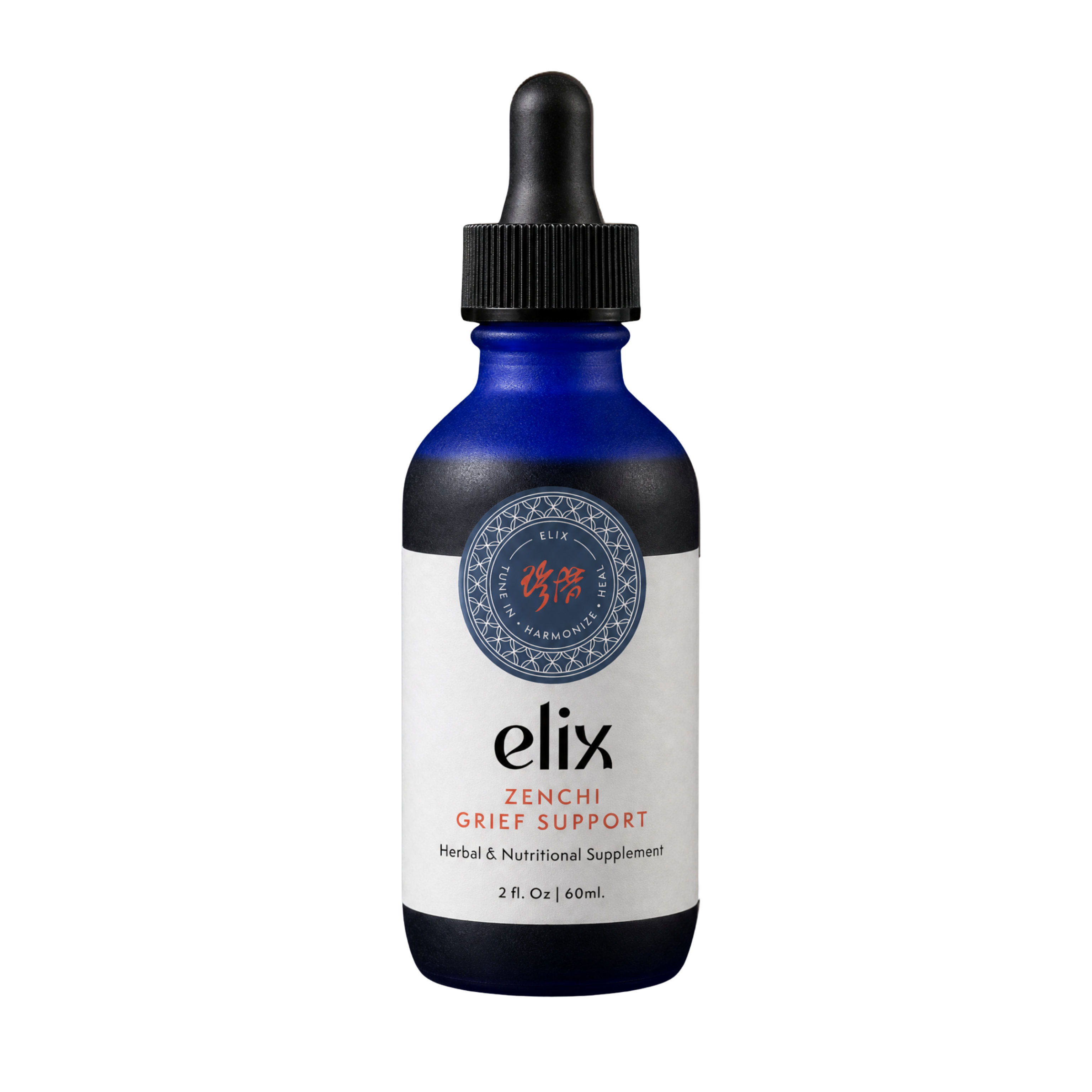
Zenchi Grief Support, Elix’s limited-edition grief support formula, was inspired by the legacy of our founder's grandparents and the remedies they leaned on through their own most difficult moments. This formula brings these time-honored, science-backed herbs together with other heart calming herbs in one gentle blend, made to care for the Heart the way generations before us did: with patience, with plants, and with love.
Bringing these herbs into your own ritual
Herbs are a companion, not a cure for the grief of loss. They work best alongside rest, connection, and, when grief is heavy, the support of a professional. But as one gentle part of tending your heart, they carry millennia of quiet wisdom.
Caring for the heart is its own kind of medicine
The deeper lesson of Chinese Medicine tradition is worth keeping: grief deserves tending, not toughing out. The Heart, broken open by loss, asks for gentleness. Answering that ask, in whatever form, is a very old and very human kind of healing.
Frequently asked questions about herbs for grief
What herbs are traditionally used for grief?
In Chinese Medicine, grief is tended with a combination of calming, spirit-soothing herbs rather than a single remedy. Among the most cherished are He Huan Pi (mimosa/silk tree bark), reishi (Ling Zhi), Bai He (lily bulb), Da Zao (jujube), and Wu Wei Zi (schisandra), often combined in a nourishing blend.
What is He Huan Pi (mimosa bark) used for?
He Huan Pi, the bark of the mimosa or silk tree, has been used for millennia in Chinese Medicine to calm the spirit and ease a heavy, sorrowful heart. Its name translates to "collective happiness," and it's traditionally regarded as the herb of joy.
Does Chinese Medicine have remedies for grief?
Yes. Chinese Medicine has a long tradition of caring for the Heart (understood as the home of the spirit) through sorrow, using calming herbs to support emotional well-being alongside rest and connection.
Can herbs really help with grief?
Herbs are traditionally used to support emotional well-being, not to treat or cure grief, which is a natural human process. Many people find a gentle herbal ritual comforting, but it works best alongside rest, support, and professional help when needed.
This article was medically reviewed by Julie Predki-Weber, L.Ac, MSOM
Julie is a licensed acupuncturist and herbalist and the Sr. Manager of Health Coaching & Clinical Strategy at Elix, where she blends Traditional Chinese Medicine with modern research to support personalized, root-cause wellness.
Sources:
-
https://my.clevelandclinic.org/health/diseases/17857-broken-heart-syndrome
-
https://www.sciencedirect.com/science/article/abs/pii/S0378874122010418
-
https://pmc.ncbi.nlm.nih.gov/articles/PMC12256279/
-
https://www.sciencedirect.com/science/article/abs/pii/S2095496426000312